
Finding Barnstable County Residents
Barnstable County has no single public list that proves who lives at every address. Its fifteen towns keep different pieces of the record. For a current property question, start with the relevant town assessor or GIS service. For a recorded transfer, use the Barnstable County Registry of Deeds. For an old household, start with a directory or local-history collection. The best result keeps the role clear: an assessor record identifies an owner for a fiscal year, a deed identifies parties to a filing, and a directory identifies a listing at its publication date.
Start narrow. A full name plus town is safer than a countywide surname search, especially where village names, seasonal addresses, and common Cape surnames overlap. Keep the source date, town, and record type beside every finding. A missing result is only a result from the source and filters used, not proof that a person was never connected with Barnstable County.
- Identify the legal town, village label, and street address or parcel number.
- Use the local assessor or GIS service for the parcel and displayed owner record.
- Search that owner as grantor and grantee in the Registry index.
- For a historical question, compare a dated directory, town record, or archive finding aid.
- Ask the actual custodian for a narrowly described public record when no online index answers the question.
Note: A person can be a recorded owner, voter, court party, directory subscriber, or licensee at different dates without being the current occupant.
Barnstable County Resident Record Offices
The main offices serve different jobs. The Registry maintains property instruments for all fifteen county towns. Barnstable town's assessor offers a useful inspected property-search example, but another county town uses its own assessor or GIS system. Voter lists are held locally by town election offices, and the statewide status screen is designed for an individual to check their own registration. The broader address path belongs on the Barnstable County street directory.
Barnstable County Registry of Deeds
Deeds & Probate Building
3195 Main Street, Barnstable, MA 02630
Barnstable Department of Assessing
Barnstable town property records
Use the local town office for parcels outside Barnstable town.
Massachusetts Elections Division
Town clerks maintain public local voter lists.
The statewide form is for individual status checks.
The county public-record route is separate from town custody. A request for a town election list should go to that town clerk, while a request for county-held material follows Massachusetts Public Records Law, M.G.L. c.66 §10 and 950 CMR 32.00.
Barnstable County Town Labels Matter
Postal labels can make a record look as if it belongs to the wrong custodian. Hyannis, Osterville, Cotuit, West Barnstable, and Wianno are villages within Barnstable town, while a name such as East Falmouth belongs to another town. A ZIP can cross that line. The county Registry's villages table is a sound first check, but the parcel record supplies the legal town that controls the assessor, clerk, tax, and local voter-list route.
For example, ZIP 02636 is used for Craigville in Barnstable and East Falmouth in Falmouth. That shared postal code is not a shared municipal records office. Write down village, legal town, ZIP, and parcel or map reference together, then search the proper municipal source.
- Parcel
- A tax-map unit used to connect a physical property with assessment data.
- Roll
- A dated list maintained for one official purpose, such as elections or taxation.
- Index
- A finding tool that points to a record, not necessarily the complete official document.
- Criss-cross directory
- A historical directory arranged by address or street rather than only by name.
Barnstable County Parcel Search Fields
The Barnstable Department of Assessing lookup is a clear model of the town-level path. It has search groups for Map/Block/Lot, owner last name, and street address. Inputs allow full or partial values. The research did not identify a ZIP search field, so a ZIP should be used to understand delivery geography, then the street, town, or parcel should drive the property search.
| Search path | Fields available | Useful result | Limit |
|---|---|---|---|
| Parcel | Map, block, lot | Durable property key | Town-specific format |
| Owner | Last name, full or partial | Displayed assessment association | Does not establish occupancy |
| Address | Street number and street name | Parcel starting point | Use legal town, not ZIP alone |
The assessor search shown here illustrates the owner, parcel, and street controls available for Barnstable town.
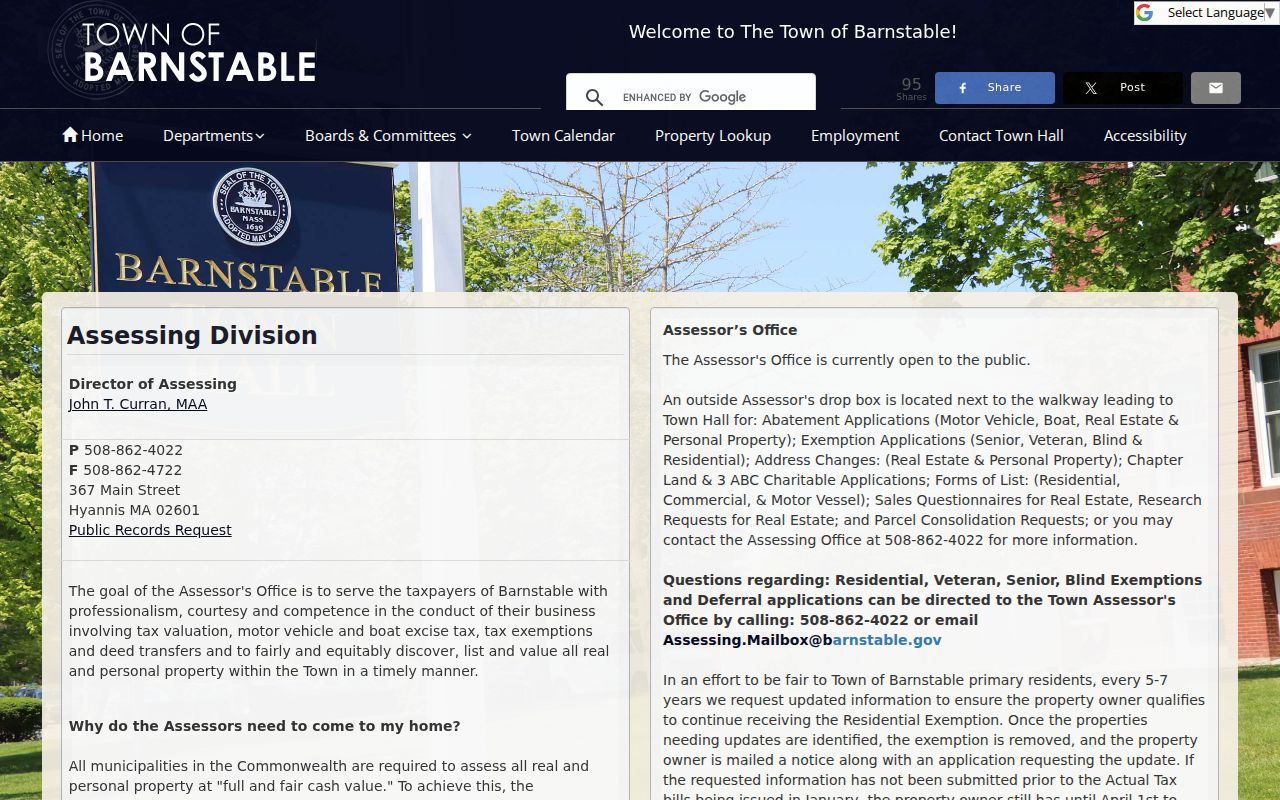
Those separate fields help keep a street spelling from being mistaken for the stronger parcel key.
Current Barnstable County Directory Sources
Current directory-like records describe different relationships. Property data is an ownership and tax association. A Registry hit records a party to an instrument. A local voter list can contain public voter fields when the town supplies them, subject to statutory redaction. Court, license, and vital systems answer narrower questions. Treating these separate lists as one live resident roll causes false matches.
| Record route | What it can establish | Custodian | Access path |
|---|---|---|---|
| Assessor or GIS | Parcel and displayed owner for a fiscal cycle | Relevant town | Town portal or office |
| Registry index | Recorded instrument parties and dates | County Registry | Free index and on-screen images |
| Local voter list | Permitted public voter fields | Town clerk or election office | Request for the applicable list |
| MassCourts | Court party, event, and disposition summary | Trial Court | Public docket search |
| State Archives index | Historical vital citation | State Archives | Searchable citation index |
A source should answer only the question it keeps. That is also why no result should be phrased as proof that a resident record does not exist.
| Official-record route | Commercial lookup category |
|---|---|
| Names the public custodian, record date, and limited field that supports a finding. | Can offer a lead, but it must be checked against the primary source and may be incomplete or stale. |
| Shows a defined relationship such as parcel owner, filing party, or dated directory listing. | Should not be treated as a current-address statement, complete household list, or proof of identity. |
Barnstable County Deed Index Trail
The Barnstable County Registry of Deeds public-access system covers Recorded Land, Land Court, plans, and address routes across all fifteen towns. Name searching accepts last name or corporation, first name, party role, document type, town, and date or index windows. Search the displayed assessor owner as both grantor and grantee, then add trust, estate, entity, and spelling variants when the instrument calls for them.
An address hit is a lead, not a title conclusion. The Registry says its address index starts in August 1993, is unofficial, and may be incomplete or unverified. When a partial street search fails, try the street root without its suffix, then return to the owner-name search. Record document number or book and page, recording date, town, parties, and document type. A deed identifies a recorded transaction, not who occupies the property.
The Registry research home separates Recorded Land, Land Court, plan, and address routes. Choosing the appropriate track prevents a short index result from being treated as a complete property history.
Note: The Registry does not perform title searches or provide legal advice, so legal reliance requires the official document and appropriate professional advice.
Barnstable County Voter Records
Massachusetts divides voter access between a personal statewide status tool and town-held public lists. The individual voter status lookup asks for first name, last name, date of birth, five-digit ZIP, and a consent checkbox. It is not a public countywide name database. For a public list, first identify the person's town and ask its clerk or election office for the appropriate annual register or street list and production format.
Local lists can include public fields such as name, address, party, date of birth, active or inactive status, and voter ID under the state's rules. Phone, email, veteran status, permanent absentee status, confidential voters, and minors are not ordinary public list fields. An inactive label is an election-administration status, not proof that someone has moved.
The Massachusetts voter status form shown here has the individual fields and consent step.
The required ZIP does not replace the town check, because several Cape ZIP codes span municipal lines.
Barnstable County Court Name Checks
A court result can help verify a specific public legal event, but it is not a general resident list. MassCourts offers court department, division, location, and result-count controls, with Name, Case Type, Case Number, and Ticket or Citation routes. The name screen is mainly for civil cases. The official instructions require at least two characters for a last name and recommend a location or short date window for a common name.
Results may show party, event, docket, and disposition data, with sortable results and pagination. The portal cautions that it is not the official record and may omit recent activity. Barnstable District Court serves Barnstable, Yarmouth, and Sandwich, while another county town's matter may be in a different court. The Superior Court's public-facing location can change during its restoration, expected to continue until a summer 2027 reopening.
The MassCourts public-record entry shown here has the portal's public-search gateway and court selectors.
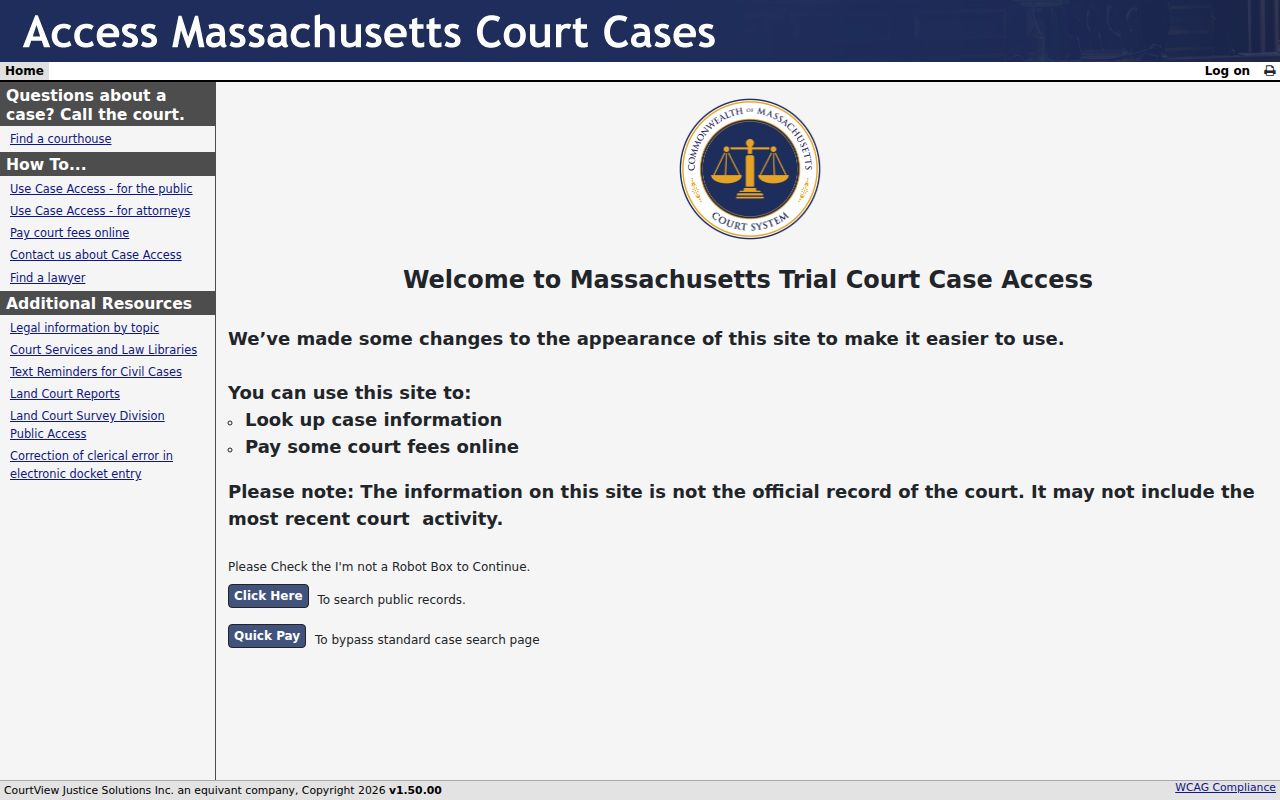
Save the court, spelling, date range, result count, and docket number so that any later file request can be checked against the same search.
Barnstable County Vital Record Dates
Vital records are strongest for dated family-history questions, not a current-address claim. RVRS generally holds records from 1936 forward, while the State Archives holds 1841 through 1935 and town clerks or local repositories are important for earlier material. Birth and marriage records older than 90 years and death records older than 50 years are the principal statutory public-access thresholds, with restrictions for parentage, adoption, and other protected information.
The Massachusetts vital-record index searches citations for 1841 through 1910 by record type, first and last name match options, location, year range, and page size. A returned citation is a research lead, not a certified copy. For modern certified copies or a live eligibility question, use RVRS ordering guidance or the relevant town clerk.
The vital-record index screen shown here makes its type, name, location, and year controls visible.
Use the citation's date and locality to choose the correct custodian instead of assuming every historical record is available online.
Historical Barnstable County Resident Directories
For a past household, libraries and archives preserve the human layer that a deed index does not. The State Library identifies Barnstable directories for 1895, 1901, and 1926, plus selected voting-list years. NARA's holdings guide points to countywide Cape directory material from 1903, 1908, 1926, and 1929. Sturgis Library holds regional genealogy, probate, family, military, and local-history material; Whelden Memorial Library has unusually specific West Barnstable indexes for people, homes, businesses, organizations, cemeteries, and events.
The 1901 Cape Cod directory at Digital Commonwealth is labeled a complete resident, street, and business directory, but its listed coverage is concentrated in Outer Cape towns. Read the town heading on the scan before treating a county-branded title as countywide coverage. The fuller collection route is on the Barnstable County city directory.
Note: A directory entry supports a dated listing, not a statement that a person lives at the address now.
Barnstable County Town Books Story
The 1827 Barnstable courthouse fire destroyed all but one of 94 deed volumes. An 1828 law allowed temporary town registries and re-recording, creating the Town Books that can bridge a property trail. That history explains why an early parcel search may jump among Town Books, Recorded Land, Land Court, probate, and local manuscripts. It is a records-custody problem, not proof that an early owner never existed.
The Registry later had computer-formatted records and scanned book images by 1999, then began e-filing in 2014. Barnstable County also announced a 2025 initiative to digitize about 3.25 million pages of eighteenth- and nineteenth-century county records, with a planned public repository. Until a live collection and its search behavior are verified, treat that project as an initiative rather than an available directory.
Barnstable County Safety Boundaries
Some public records are deliberately incomplete. The Massachusetts Address Confidentiality Program provides substitute addresses for eligible survivors and protected health providers. Confidential-voter rules also protect qualifying addresses. A suppressed result should never be reverse-engineered through parcel, deed, court, or directory clues. Massachusetts law also permits exemptions and redactions, even where another narrow field is public.
Use official portals directly, record source dates, and ask for only the fields needed. The Registry's consumer-alert material recommends using its official site rather than responding to an unsolicited request for payment. A narrow records request can ask for a defined office, record class, date range, and electronic delivery, rather than asking a clerk to assemble a countywide list of people.
The Massachusetts SORB information page is an example of a specialized public record with specific access and use limits.
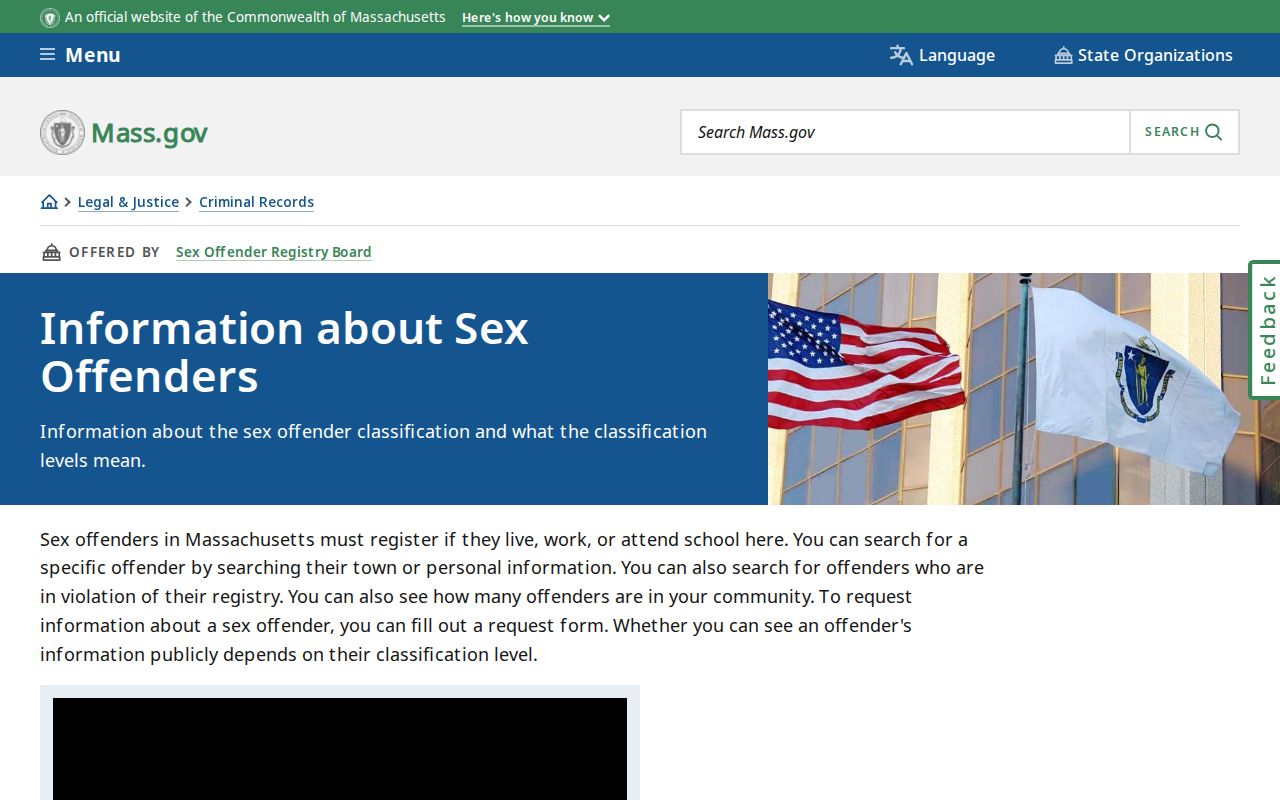
Specialized registries answer a narrow legal-status question and should not be turned into a claim about a person's current address.